
Skip to content

VGEC: Vietnamese Grammatical Error Correction Challenge Subtask 1 Constrained-Resource

Organized by phng - Current server time: Oct. 12, 2026, 10 p.m. UTC

Current

Public Test
Oct. 2, 2026, midnight UTC

Next

Private Test
Oct. 15, 2026, midnight UTC

End

Competition Ends
Oct. 22, 2026, midnight UTC
Important Dates

September 25: Training Data Release

October 2: Public Test Release

October 15: Private Test Release

October 22: Result Announcement

October 29: Paper Submission

November 5: Acceptance Notification

November 12: Camera-ready Deadline

November 15: Workshop Date

Task Description

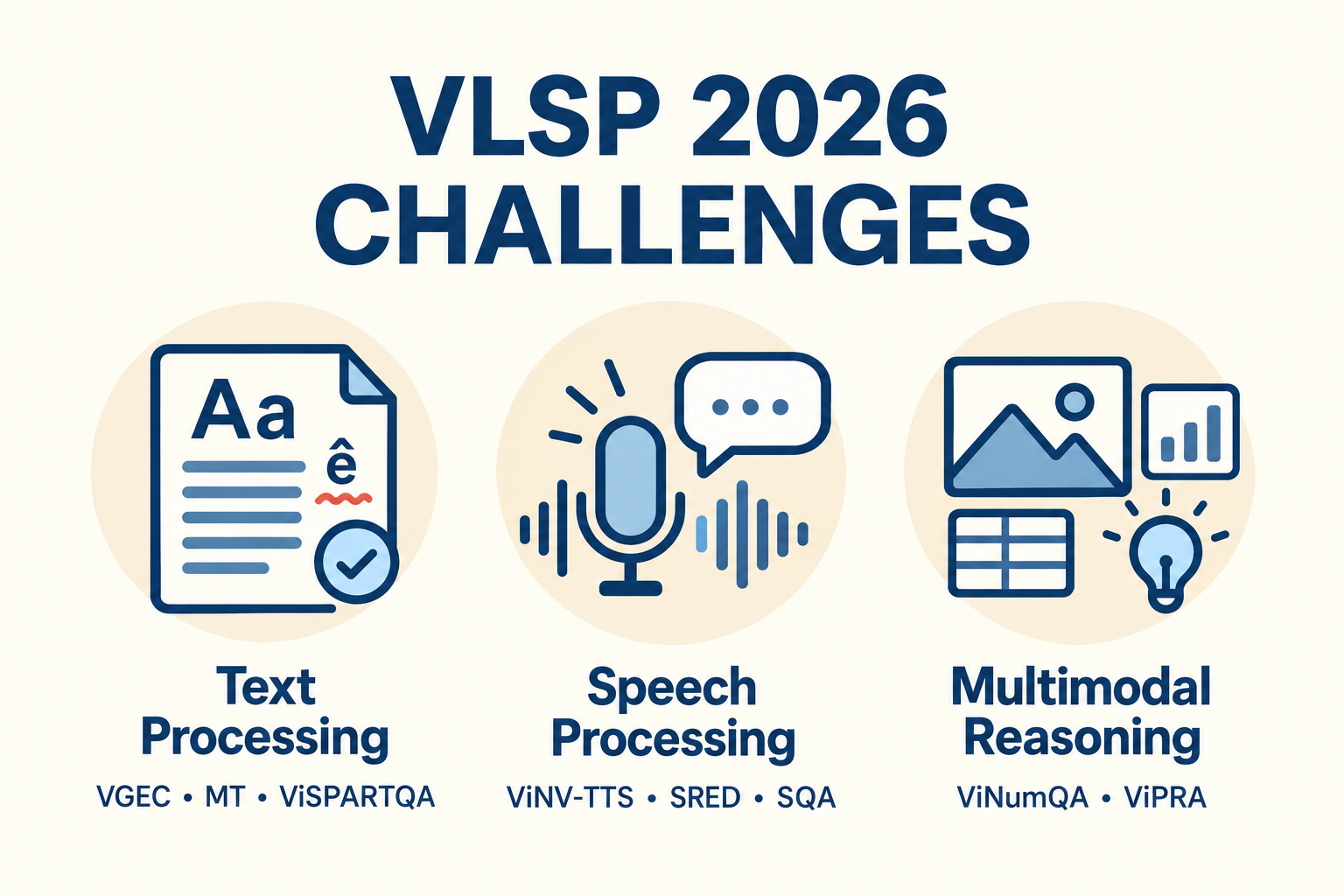
The Vietnamese Grammatical Error Correction (VGEC) Challenge aims to foster research and development in natural language processing for the Vietnamese language, specifically focusing on error detection and correction.

Participants are required to build models capable of taking sentences written by native speakers and non-native Vietnamese learners (or grammatically flawed sentences) as input, identifying the error types, and producing grammatically correct, fluent target sentences in Vietnamese.

Unlike standard text editing tasks, the VGEC benchmark evaluates both the capability to categorize error types (including sentences that require no edits) and generating valid, fluent corrections.

Task Setting and Participation Rules
  • Single Subtask: The challenge features one official evaluation track covering Vietnamese grammatical error identification and sentence correction.
  • Model Size Constraint: Each individual model used in the submitted system must have no more than 8 billion parameters (≤ 8B). Ensembles or multi-stage pipelines are permitted only if each individual component model satisfies this constraint.
  • External Data: The use of external resources (pre-trained language models, public parallel corpora, synthetic datasets) is permitted, provided they are thoroughly documented in the submitted paper.
  • Model-Generated External Data: Any synthetic data generated using Large Language Models or generative pipelines must be produced by models conforming to the ≤ 8B parameter limit.
  • External Data Disclosure & Submission: All external datasets and generation pipelines must be clearly documented in the system report and submitted or made accessible to the organizers upon request.
  • Official Ranking: Compliance with both the model size limits and external data regulations is mandatory for eligibility on the official leaderboard.
Organizers
  • Hien Pham, Hanoi University of Industry ([email protected])
  • VLSP 2026 Organizing Committee
Contact

Zalo Group: []

Registration

https://forms.gle/NGpzmhAqZgWjxFHz5

References
  1. Hwee Tou Ng et al. 2014. The CoNLL-2014 Shared Task on Grammatical Error Correction. In Proceedings of CoNLL 2014.
  2. Courtney Napoles et al. 2017. JFLEG: A Fluency Corpus and Benchmark for Grammatical Error Correction. In Proceedings of EACL 2017.
  3. VLSP Shared Task Proceedings (2020–2025). Vietnamese Language and Speech Processing.
Evaluation Metric

Submitted systems are evaluated across two key aspects: Error Classification and Sentence Correction Quality.

1. Error Type Classification:

Evaluated using Macro-F1 and Micro-F1 scores on the predicted Error_Type_Id (from 0 to 4). Macro-F1 gives equal importance to all error types, while Micro-F1 reflects overall classification performance.

2. Grammatical Error Correction:

The fluency, correctness, and overlap of generated sentences against reference corrections are evaluated using the following metrics:

  • GLEU+: An n-gram-based metric adapted for grammatical error correction that rewards matching n-grams while penalizing n-grams inappropriately retained from the erroneous source.
  • Exact Match (EM): Measures the proportion of generated corrections that are strictly identical to the gold references.
  • ROUGE-L: Measures sequence-level similarity based on the Longest Common Subsequence (LCS) between the prediction and reference.

Official Ranking:

The final official ranking on the leaderboard will be determined by the Average of Macro-F1 and GLEU+, providing a balanced assessment of both the system's ability to classify errors correctly and its ability to generate high-quality corrections.

Submission Format

Participants must prepare their prediction file as a JSON array named results.json, where each element maps the sample ID to the predicted Error_Type_Id and the corrected string (or list of candidate corrections). For example:

[
  {
    "ID": 1,
    "Output": {
      "Error_Type_Id": 1,
      "Fixed Sentence": [
        "...sau khi được đồng chí Lê Nhựt Tân cho biết thành phố có Hội Bảo trợ..."
      ]
    }
  },
  {
    "ID": 3,
    "Output": {
      "Error_Type_Id": 0,
      "Fixed Sentence": []
    }
  }
]

Name the file as results.json and compress it into a zip archive:

results.zip
•  results.json

To create a valid submission, zip the file directly with: zip -r results.zip results.json. DO NOT zip the parent folder itself, only its contents.

Terms and Conditions

By participating in the Vietnamese Grammatical Error Correction (VGEC) shared task, you agree to the following terms:

  • Each individual model used in your system pipeline must have no more than 8 billion parameters (≤ 8B).
  • All external datasets, pretrained weights, and data augmentation resources must be documented in your system description paper.
  • Any external synthetic data generated via generative models must also strictly comply with the ≤ 8B model parameter limitation.
  • Any external datasets used must be made accessible to the organizers upon request for verification.
  • Compliance with both the model size limits and external data transparency rules is mandatory for inclusion on the official final leaderboard.

Public Test

Start: Oct. 2, 2026, midnight

Private Test

Start: Oct. 15, 2026, midnight

Competition Ends

Oct. 22, 2026, midnight

You must be logged in to participate in competitions.

Sign In